Most water treatment dealers keep prices off their websites. The reasons are familiar: every house is different, competitors will undercut you, and a number on a screen can scare people off before you’ve explained anything.
Homeowners search for prices anyway. And right now, the answers they find mostly don’t come from dealers.
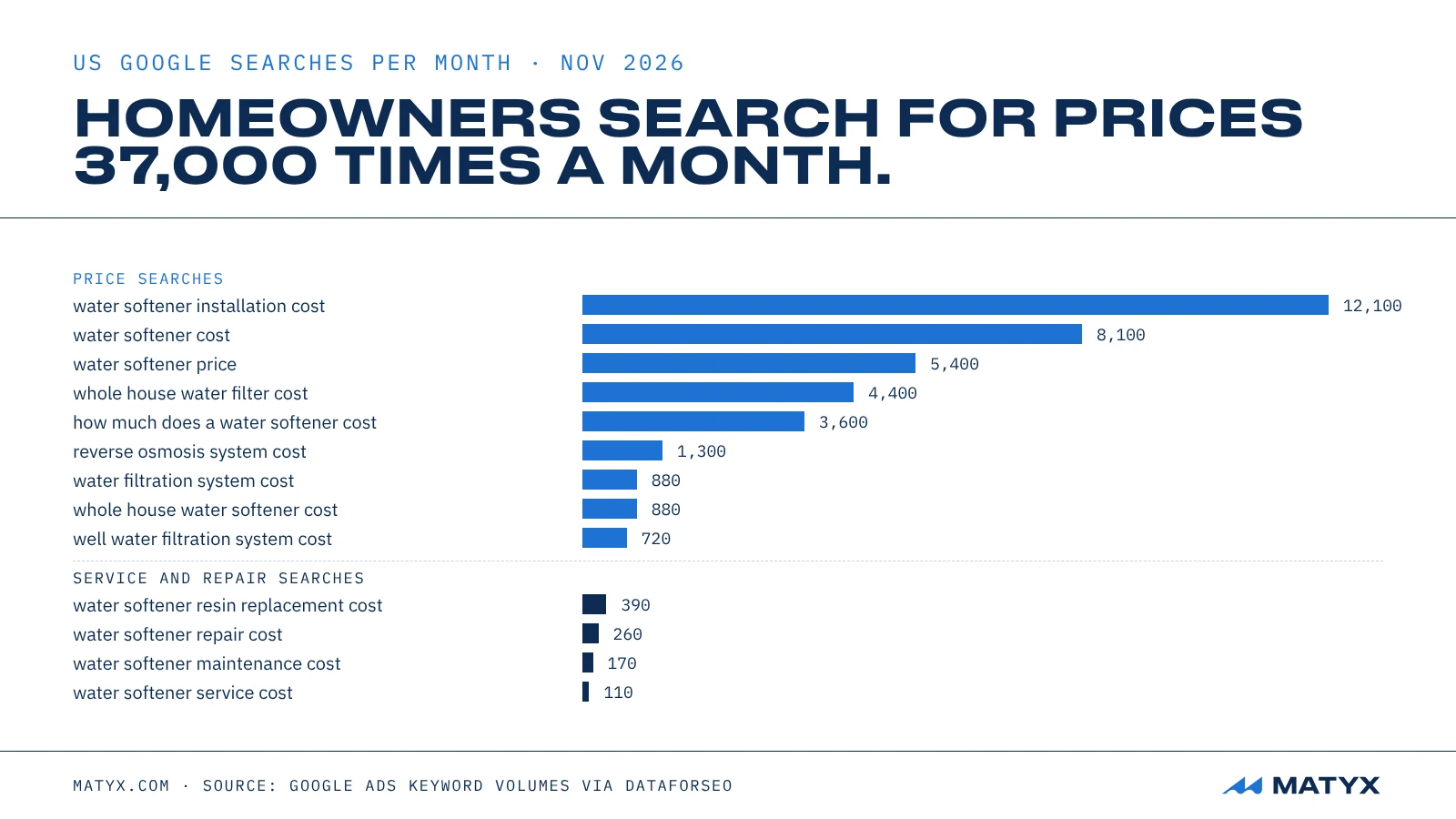
In the US, “water softener installation cost” gets about 12,100 searches a month. “Water softener cost” gets about 8,100, and it jumped to around 49,500 in October 2026. Add “water softener price,” “whole house water filter cost,” “reverse osmosis system cost” and a few others, and it comes to more than 37,000 price searches a month.
Look at what comes up for the biggest of those searches and it’s thin. Google’s AI summary answers first, citing a cost calculator from a contractor software company, a Facebook thread, an online softener seller and a YouTube short. Below it: one local dealer’s cost page, two Facebook group threads, a lead-generation estimates site and the online seller again.
That AI summary also quotes big-box softeners at a few hundred dollars for the equipment alone. If that’s the only number a homeowner has seen, your quote will look high before you’ve said a word. If your number, with what it includes, is the one they find, the conversation starts in a different place.
We studied more than 64,000 Google reviews of more than 900 US water treatment dealers. Prices rarely come up, and when they do, it’s mostly because someone felt surprised.
The people who praise a dealer on price usually describe comparing quotes, sometimes finding a local dealer at half the price of a national brand or a big plumbing company. Clear numbers help the buyer who’s already comparing.
You don’t need exact quotes. You need honest ranges and an explanation of what moves them.
Write it as questions and answers, in plain words. That’s how homeowners ask, and it’s what AI assistants pull from. In our ChatGPT test, ChatGPT gave homeowners price ranges and told them to ask for an itemized quote and ongoing costs. Be the dealer whose website already answers both.
“Every house is different.” True, which is why you publish ranges and the things that move them, not a single number.
“Competitors will undercut me.” They can already get your prices by calling or by asking one of your customers. In our review study, homeowners who compared quotes often picked the dealer who explained the water best, not just the cheapest. A clear price page is part of that explanation.
“A number will scare people off.” They’ve already seen a number. The question is whether it’s yours, with what it includes, or an equipment-only figure from a big-box store.
“My brand has rules about pricing.” Follow them. You can still publish what’s included, your service rates and the yearly cost of ownership.
Since service bills cause more price complaints than system prices, a price page is only half the fix.
Give each system its own cost page or section, link to it from your service and town pages, and use the questions homeowners actually type as your headings. A page like this can show up in Google’s AI summary as well as the regular results. Price and FAQ pages are part of how we approach web design and SEO and AEO for dealers.
If you’d like help writing your price page or seeing where you show up for price searches in your area, get in touch.
Yes, as honest ranges with what’s included and what moves the price. Homeowners search for prices tens of thousands of times a month, and the dealer who answers is the one they find and trust.
Installed ranges by system type, what changes the price, what’s included, service and repair prices, and the yearly cost of salt, filters and service.
In our review study, most price complaints in 3- and 4-star reviews were about service bills, not the system price. Customers compare how long the tech was there to what they were charged.
"Ranking for water treatment terms is easy. Ranking for the ones that turn into installs is the job."