


Homeowners pick a water treatment dealer by reading what other homeowners wrote. So this fall, our team read it too: 64,344 Google reviews of nearly 900 US residential water treatment dealers.
We hand-coded every 1- and 2-star review, every 3- and 4-star review, and 1,200 of the longest 5-star reviews, then tagged the rest by keyword. Here’s what we found, and what we’d do about it.
Homeowners search by water problem: hard water, iron stains, a smell. But that’s not what they write about afterward. Only 16.4% of reviews with text mention a softener, 8.9% mention reverse osmosis or drinking water, and no single water problem comes up in more than 5% of them.
What they write about is the people. 47% of 5-star reviews name a staff member, against 16% of 1–2 star reviews. And what they praise most is being told what’s going on.

Words like “explained” and “walked us through” appear in 14.8% of 5-star reviews and 5.1% of 1–2 star reviews. “Answered all our questions” shows up in 3.0% of 5-star reviews and in none of the 1–2 star ones.
That lines up with what ChatGPT now tells homeowners before they call anyone: get a real water test and an explanation, not a sales pitch. We wrote about that in what ChatGPT says when asked to pick a water softener company.
For your website, it means putting your people on it, by name, and writing your pages the way your 5-star customers talk. That’s how we approach web design for water treatment dealers.
We read every 1- and 2-star review in the set, 2,116 of them, and coded what went wrong. A review can name more than one cause.
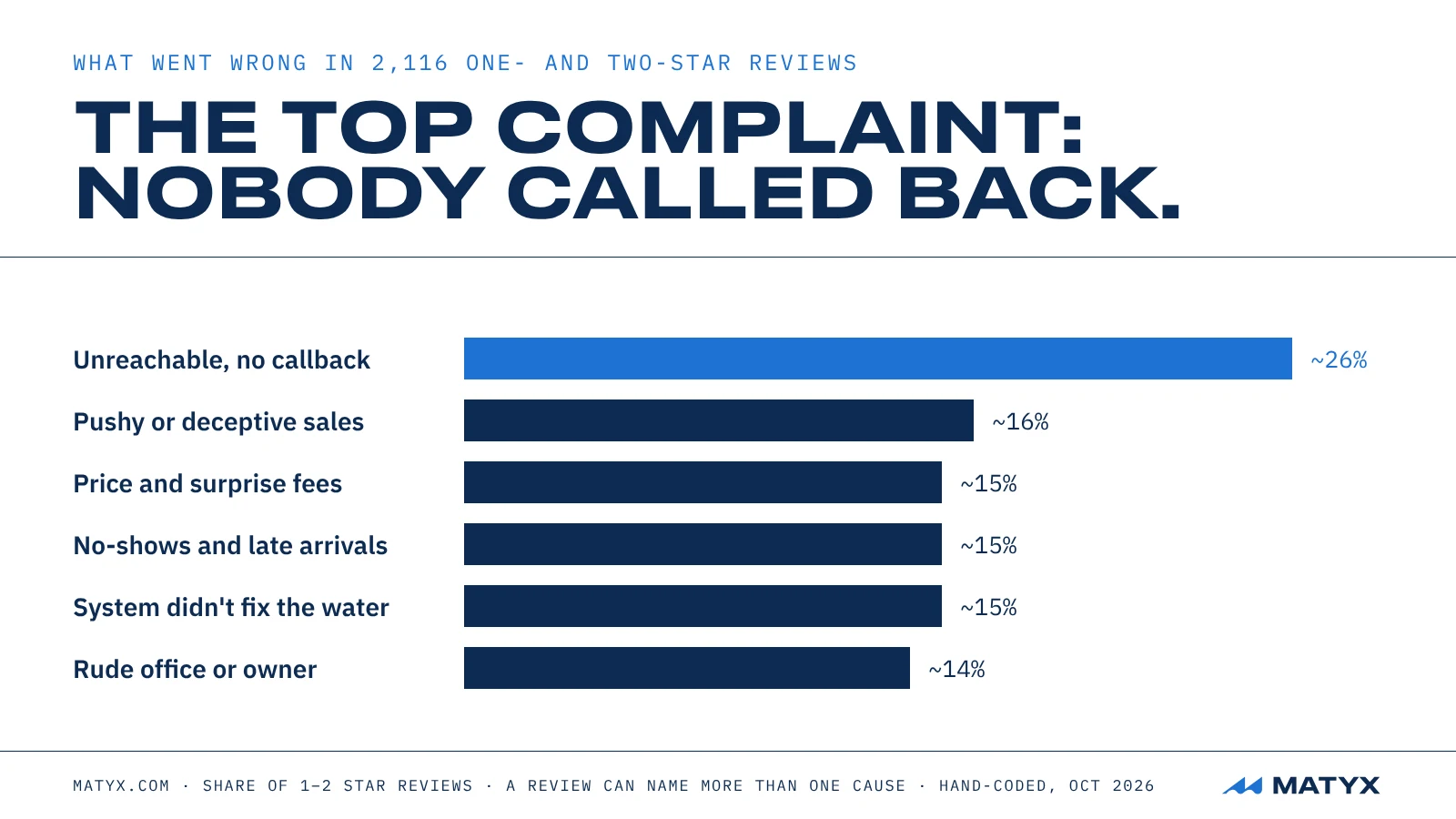
The phrases that set bad reviews apart are “was told,” “no one,” “no call” and “no response.” They describe broken communication far more often than bad water.
The office does more damage than the field. In every batch we coded, 10 to 20 reviews praised the tech by name and blamed dispatch, the front desk or billing for the low rating. Words about the office or customer service appear in 22.4% of 1–2 star reviews, against 9.0% of 5-star reviews. Scheduling and arrival-window words appear in 17.9%, against 5.0%.
And those reviews stick. The median 1–2 star review runs 404 characters, against 163 for a 5-star review. A one-line “Great service!” doesn’t hold the eye the way a full paragraph about three unreturned calls does.
An unreturned call also hides in your numbers: in a lead report, a lead nobody called back looks exactly like a bad lead. We dug into that in Bad Leads or Missed Leads? A CRM that assigns every call and form to someone, and flags the ones nobody touched, fixes most of it.
Across the whole set, 3.7% of reviews are 1 or 2 stars. When a reviewer mentions how the dealer first reached them, that share swings widely:
About 1 in 7 one-star reviewers never bought anything. They were reacting to the marketing itself. The water test isn’t the problem; the bait around it is. The full breakdown, including mailers and in-store survey teams, is in our lead quality post, and it’s why our paid ads aim at homeowners already searching for help with their water.
The median dealer in our set gets 1.8 new Google reviews a month, and 21% had none in the previous 90 days. 16% never reply to a review, while 34% reply to 90% or more.
The dealers who do the work have better numbers:
That’s a correlation, not proof that replying raises a rating. Busier, better-run shops tend to do both. But two details point to things any dealer can change.
First, owners reply least to the reviews that matter most: 64% of 5-star reviews get a reply, against 50% of 1-star reviews.
Second, the kind of reply matters. A quick call or visit that fixes the problem often turns a 1-star review into a 3 or 4. Public replies that argue the facts, say “we have no record of you,” or tell the customer to call the office (when the office was the complaint) tend to get a longer, angrier update.
The Google Business Profile itself is mostly left alone, too. Only 20.7% of dealers had a recent post on their profile, and 16.6% list their services there. Reviews, replies and the profile are all part of our SEO and AEO work for dealers.
The long 5-star reviews and the 1-star reviews tell the same stories from opposite ends. A few moments come up again and again.
If we ran a dealership, these are the first six things we’d do with this.
We’ll go deeper on each of these in the coming weeks. If you’d like a look at what your own reviews say and what to fix first, get in touch.
In late September 2026, we pulled up to the 100 newest Google reviews for nearly 900 US residential water treatment dealers: 64,344 reviews, 53,580 of them with text. In October, we hand-coded every 1–2 star review (2,116), every 3–4 star review (831) and 1,200 long 5-star reviews, and tagged every review with text by keyword.
A few limits worth knowing. The dealers aren’t a random sample; they’re dealers on our prospecting list. Pulling the newest reviews means most are from 2025 and 2026. Google reviews skew positive, so the causes of bad reviews are shares of a small pool. Keyword tagging misses paraphrase, so tagged figures are floors. Where we had both, we used the hand-coded figure. And the reply and review-pace results are correlations, not proof of cause. We haven’t named any dealer or reviewer.
"They're not just winning more jobs this quarter. They finally know how and where dollars are coming in from."


