


For a lot of dealers, the free water test is the front door. It’s how most new customers first meet the company. It’s also, for some dealers, where their worst reviews come from.
Same offer, opposite outcomes. When we studied more than 64,000 Google reviews of more than 900 US water treatment dealers, the difference came down to how the test was offered, booked and run.
The in-home water test is the single moment customers praise most in long 5-star reviews, mentioned in 12–16% of them. About 2.5% of long 5-star reviews were written by people who had only had a test or a consultation and hadn’t bought anything yet. A good test earns a good review on its own.
The trouble is the bait around it. When a reviewer mentions a gift-card offer, a “free water test” promotion or a survey, 37.9% of those reviews are 1 or 2 stars, against 3.7% across all the reviews. About 1 in 7 one-star reviewers never bought anything. Their only contact with the dealer was the offer itself.
Homeowners say the same thing online. One of the most upvoted posts we found was about a free test kit from a home improvement store, followed by a call saying the spouse “must be present.” Others call the in-home visit a “sales pitch hostage situation,” or simply ask: “is this water testing offer a scam?”
The 1- and 2-star reviews describe the same few things again and again:
None of these are about the water test. They’re about what’s wrapped around it.
The fix starts with the words in your ad, mailer or landing page.
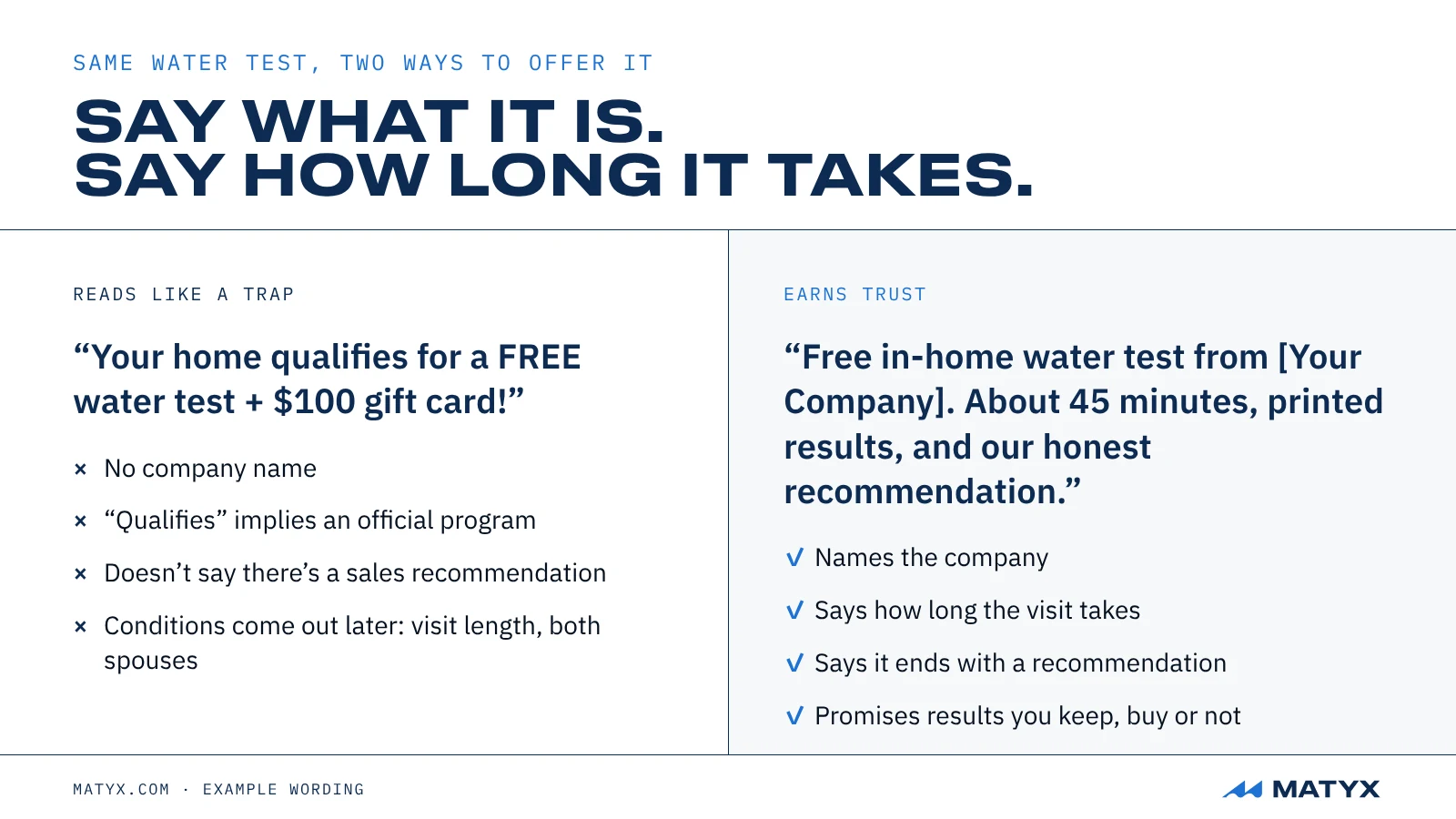
Name your company. Say it’s an in-home water test, how long it takes, and that it ends with a recommendation. People don’t mind a recommendation. They mind finding out about it halfway through.
Some dealers drop “free test” language altogether. One owner we work with doesn’t offer free tests at all. His line to customers is “don’t fall for the free water test,” and he sends samples to certified labs. For his site we’re looking at a free water quality report instead, built from the town-by-town water analyses he already has, with a short form for the full report. Another of our clients already frames its offer that way.
There’s no single right offer. A free in-home test, a free report for your town, and a paid lab test can all work. What matters is that the homeowner knows exactly what they’re getting.
The best reviews describe a tech who explains each number as it comes up and ties every recommendation to it.
It also matches what ChatGPT tells homeowners before they call anyone: get a real test and an explanation, not a sales presentation. We wrote about that in what ChatGPT says when asked to pick a water softener company.
A test offer can look cheap on cost per lead and still lose money, or look expensive and pay off well. One of our clients judges its test offers on the sales they produce, not the cost per lead, and that’s the right call. We showed how to do that math in Is Your Marketing Profitable?
In-store survey programs at home improvement stores carry some of the worst ratings in the study: 30% of reviews that mention a big-box store are 1 or 2 stars. Yet one of our clients gets qualified leads from an in-store program. The difference is how it’s run. A clear offer, an honest booking and a real test hold up wherever the lead comes from.
We build paid ads for water treatment dealers around offers like this, with the results tracked to booked tests and sales. If you’d like a second opinion on your offer, get in touch.
Yes, if it’s honest. The in-home test is what customers praise most in 5-star reviews. The problems come from hidden conditions, late surprises and pressure, not from the test.
Say up front how long the visit lasts and keep to it. We recommend 45 to 60 minutes. A “45-minute” test that ran three hours is one of the most common complaints in the bad reviews.
For some problems, yes. Offer a lab test when arsenic, nitrate, bacteria or PFAS could be involved. Some dealers lead with a free water quality report for the town and offer a lab test from there.
"They're not just winning more jobs this quarter. They finally know how and where dollars are coming in from."


